
Affiliate marketing has become one of the most popular ways for businesses and marketers to generate sales, leads, and online revenue. Unlike traditional advertising, affiliate marketing allows businesses to work with affiliates who promote their products or services and earn a commission when a desired action takes place.
However, simply joining an affiliate program and sharing affiliate links is not enough to achieve consistent results. Successful affiliate marketing depends heavily on Performance Tracking in Affiliate Marketing. Marketers need to know which links generate clicks, which campaigns produce conversions, which products perform best, and where their traffic and revenue are coming from.
Performance Tracking in Affiliate Marketing helps marketers make decisions based on actual data rather than assumptions. It allows them to identify successful strategies, reduce wasted effort, improve campaigns, and increase their return on investment.
In this blog, we will explore what Performance Tracking in Affiliate Marketing means, why it is important, the key metrics to monitor, useful tracking methods, common mistakes, and proven strategies for improving affiliate marketing performance.
What Is Performance Tracking in Affiliate Marketing?
Performance Tracking in Affiliate Marketing is the process of monitoring and analyzing the results of affiliate marketing activities. It helps marketers understand how their campaigns are performing and identify opportunities for improvement.
When an affiliate promotes a product using a unique affiliate link, tracking systems record important information about users who interact with that link. Depending on the affiliate program and tracking setup, marketers can monitor clicks, conversions, sales, commissions, traffic sources, and other activities.
For example, imagine an affiliate promotes a smartphone through a blog post. The affiliate link receives 1,000 clicks and generates 30 purchases. Through Performance Tracking in Affiliate Marketing, the affiliate can analyze this data to understand how effectively the campaign performed.
Performance Tracking in Affiliate Marketing answers important questions such as:
- How many people clicked the affiliate link?
- Where did the visitors come from?
- How many visitors converted?
- Which product generated the most sales?
- How much commission was earned?
- Which campaign produced the highest return?
- Which traffic source performed best?
These insights help affiliates improve their marketing strategies and make more data-driven decisions.
Why Is Performance Tracking Important?
Performance Tracking in Affiliate Marketing is important because affiliate marketing involves many variables. An affiliate may promote multiple products across different platforms, including websites, social media, email newsletters, YouTube, and paid advertising.
Without Performance Tracking in Affiliate Marketing, it can be difficult to determine which activities are actually generating results and which strategies need improvement. By monitoring performance data, affiliates can identify successful campaigns, optimize their marketing efforts, and make more informed decisions
1. Helps Measure Campaign Performance
Tracking allows affiliates to see whether their campaigns are successful.
For example, an affiliate may promote the same product on Instagram, YouTube, and a blog. If the blog generates more conversions than Instagram, the affiliate can focus more resources on content that performs well.
2. Helps Understand the Audience
Performance data provides valuable information about audience behavior.
Affiliates can learn which products people are interested in, which content attracts attention, and which calls-to-action encourage users to click.
Understanding the audience makes it easier to create relevant content and recommendations.
3. Helps Increase Revenue
Tracking makes it possible to identify high-performing products and campaigns.
If one product consistently generates more conversions and commissions than another, the affiliate can create additional content around that product or promote it through other suitable channels.
4. Reduces Wasted Marketing Spend
Paid affiliate campaigns can become expensive if they are not monitored properly.
Performance tracking helps identify campaigns that generate poor results so marketers can adjust or stop them before wasting more money.
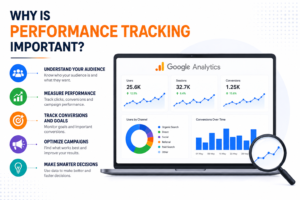
5. Supports Data-Driven Decisions
Instead of guessing what works, affiliates can use real performance data to make decisions.
This creates a continuous cycle of:
Track → Analyze → Optimize → Test → Improve
Important Affiliate Marketing Metrics
To effectively track affiliate performance, marketers need to understand the most important metrics.
Clicks
Clicks represent the number of times users click an affiliate link.
This metric helps determine whether promotional content is attracting attention.
For example, if an affiliate link receives very few clicks, the problem may be the placement of the link, the content, the headline, or the call-to-action.
However, clicks alone do not indicate success. A campaign can generate thousands of clicks but very few sales.
Click-Through Rate (CTR)
Click-through rate measures the percentage of users who click a link after seeing it.
A higher CTR generally indicates that the content or advertisement is successfully encouraging users to take action.
For example, if 1,000 people see a promotional banner and 50 click it, the CTR is 5%.
CTR is especially useful for comparing different advertisements, headlines, buttons, and content formats.
Conversions
Conversions are one of the most important metrics in affiliate marketing.
A conversion occurs when a visitor completes the desired action. Depending on the affiliate program, this could be:
- Making a purchase
- Signing up for a service
- Submitting a lead form
- Installing an application
- Starting a subscription
- Completing another qualifying action
Tracking conversions allows affiliates to determine whether their traffic is producing meaningful results.
Conversion Rate
Conversion rate shows how effectively clicks turn into conversions.
For example, if an affiliate receives 500 clicks and generates 25 sales, the conversion rate is 5%.
A high conversion rate can indicate that the affiliate is sending relevant traffic to a suitable product.
Commission
Commission represents the amount earned from successful affiliate conversions.
Monitoring commissions helps affiliates understand which products and campaigns generate the most income.
Earnings Per Click (EPC)
Earnings per click, commonly known as EPC, helps affiliates understand how much revenue is generated on average from clicks.
EPC can be useful when comparing different affiliate offers.
An offer with a higher EPC may be more attractive because it generates more earnings relative to the traffic being sent.
Return on Investment (ROI)
ROI measures the profitability of a marketing activity.
This becomes especially important when affiliates spend money on paid advertising.
If an affiliate spends ₹10,000 on advertising and earns ₹15,000 in commission, the campaign may be profitable after considering other costs.
Tracking ROI helps marketers determine whether their campaigns are financially sustainable.
Tracking Traffic Sources
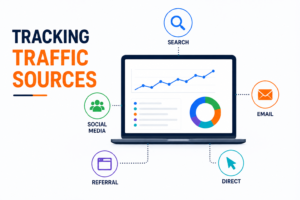
Knowing where visitors come from is essential for Performance Tracking in Affiliate Marketing. Understanding traffic sources helps affiliates identify which channels generate the most valuable visitors and conversions.
Traffic can come from various sources, including:
- Google search
- Social media
- YouTube
- Email marketing
- Paid advertising
- Referral websites
- Direct traffic
For example, an affiliate may discover that Google search generates fewer visitors than social media but produces significantly more purchases.
This information can help determine where to focus future marketing efforts and improve Performance Tracking in Affiliate Marketing strategies.
Using tracking parameters such as UTM parameters can also help marketers distinguish between different campaigns and traffic sources.
For example, separate tracking parameters can be used for an Instagram campaign, Facebook campaign, email campaign, and blog promotion.
This makes campaign analysis more detailed and organized, enabling more accurate Performance Tracking in Affiliate Marketing and better decision-making.
Using Analytics Tools for Affiliate Tracking
Affiliate marketers can use several types of tools to monitor performance. Effective Performance Tracking in Affiliate Marketing relies on using the right tools to measure clicks, conversions, commissions, and other important metrics.
Affiliate networks often provide built-in dashboards that show clicks, conversions, commissions, and other statistics. These dashboards play a key role in Performance Tracking in Affiliate Marketing by helping marketers evaluate campaign results and identify improvement opportunities.
Website analytics platforms can provide additional information about visitor behavior, landing pages, traffic sources, and engagement.
For example, an affiliate blogger can use analytics to determine which blog posts attract visitors and which pages encourage users to click affiliate links.
Link management tools can also help marketers organize and monitor multiple affiliate links.
The best tracking setup depends on the affiliate program, website, traffic sources, and marketing strategy. By implementing the right tools and processes, Performance Tracking in Affiliate Marketing becomes more accurate, efficient, and valuable for long-term success.
Tracking Different Affiliate Campaigns
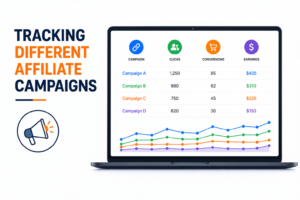
One of the best practices in affiliate marketing is to separate campaigns.
Suppose an affiliate promotes a product using three different strategies:
- Blog article
- Instagram post
- YouTube video
Using separate tracking links makes it easier to determine which strategy generates the most clicks and conversions.
If the YouTube campaign produces significantly more sales than the other two channels, the affiliate can invest more effort into video content.
Campaign-level tracking also makes testing easier.
A/B Testing for Affiliate Marketing
Performance tracking becomes even more powerful when combined with A/B testing.
A/B testing involves comparing two versions of a marketing element to determine which performs better.
For example, an affiliate could test:
- Two different headlines
- Two call-to-action buttons
- Different affiliate link placements
- Different images
- Different landing pages
- Different promotional messages
Suppose Version A generates a 3% conversion rate while Version B generates a 6% conversion rate.
The affiliate can use the data to determine that Version B performs better and continue testing improvements.
Small changes can sometimes produce significant improvements over time.
Common Performance Tracking Mistakes
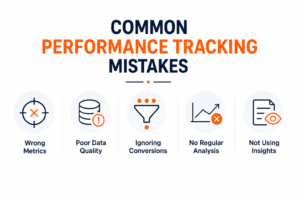
Although tracking is important, affiliates can make several mistakes.
Focusing Only on Clicks
High click numbers do not necessarily mean high revenue.
Affiliates should evaluate clicks alongside conversions, commission, and ROI.
Not Tracking Individual Campaigns
Using the same tracking link everywhere makes it difficult to determine which channel is responsible for conversions.
Separate campaign tracking provides better insights.
Ignoring Conversion Quality
Some campaigns may generate many conversions but low-value customers.
Affiliates should consider not only the number of conversions but also the revenue and commission generated.
Making Decisions Too Quickly
A campaign may perform poorly during its first few days and improve later.
Marketers should collect enough meaningful data before making major decisions, while still monitoring campaigns for obvious problems.
Not Checking Tracking Accuracy
Broken affiliate links, incorrect tracking parameters, or technical issues can lead to inaccurate data.
Affiliates should regularly test their links and tracking setup.
How to Improve Affiliate Marketing Performance
Once performance data is available, affiliates can use it to improve their strategies.
First, identify the products that generate the strongest results.
Second, determine which traffic sources produce the most valuable visitors.
Third, improve content around high-performing topics.
Fourth, experiment with different calls-to-action and affiliate link placements.
Fifth, remove or reduce effort spent on consistently poor-performing campaigns.
It is also useful to focus on audience intent. Visitors who are actively searching for product reviews, comparisons, tutorials, or buying guides may be more likely to convert than visitors who encounter a random promotional message.
Therefore, creating useful and relevant content can be more effective than simply placing affiliate links everywhere.
The Role of Content in Performance Tracking
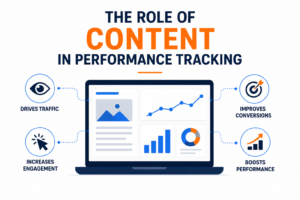
Content and performance tracking work together closely.
An affiliate website may publish product reviews, comparison articles, tutorials, buying guides, and informational blog posts.
Analytics can help identify which types of content generate the most valuable traffic.
For example, a comparison article may attract fewer visitors than a general informational article but generate significantly more affiliate sales.
This indicates that the comparison article may have stronger purchase intent.
By identifying these patterns, affiliates can develop more content around topics that contribute to conversions.
Building a Data-Driven Affiliate Marketing Strategy
Successful affiliate marketers treat performance tracking as an ongoing process rather than a one-time activity.
A strong strategy starts by defining clear objectives.
For example:
- Increase affiliate clicks
- Improve conversion rate
- Increase monthly commission
- Reduce advertising costs
- Improve ROI
- Grow organic traffic
Next, marketers select the right metrics and tracking methods.
After collecting data, they analyze performance and identify opportunities.
The final step is optimization.
This process should be repeated regularly because audience behavior, competition, products, and marketing platforms can change over time.
Conclusion
Performance tracking is one of the most important elements of successful affiliate marketing. It helps affiliates understand how their campaigns are performing and provides the information needed to make smarter marketing decisions.
By monitoring metrics such as clicks, CTR, conversions, conversion rate, commission, EPC, and ROI, affiliates can understand which strategies are producing real results.
Tracking traffic sources can reveal where valuable visitors come from, while campaign tracking and A/B testing can help improve individual marketing activities. Analytics also allows affiliates to understand customer behavior and create more relevant content.
The key is to avoid focusing on a single metric. A large number of clicks may look impressive, but conversions, commission, and profitability ultimately determine whether an affiliate campaign is successful.
Affiliate marketing becomes much more effective when marketers follow a data-driven approach: track performance, analyze the results, optimize campaigns, and continuously test new strategies.
In a competitive digital marketing environment, performance tracking gives affiliates a clear view of what is working and what needs improvement. Instead of relying on guesswork, marketers can use real data to improve their campaigns, attract better-quality traffic, increase conversions, and build a more profitable affiliate marketing business.