
In today’s digital world, having an online presence is not enough to make a business successful. Businesses need to understand how people interact with their websites, where visitors come from, what they do after arriving, and whether marketing campaigns are actually producing results. This is where Google Analytics becomes an important tool for digital marketing.
Google Analytics is a web analytics platform that helps businesses collect and analyze data about website and app users. It provides valuable information about visitors, their behavior, traffic sources, conversions, and marketing performance. For digital marketers, this data can help transform assumptions into measurable strategies.
Whether you are a small business owner, blogger, e-commerce company, or professional digital marketer, understanding Google Analytics can help you make better marketing decisions. In this blog, we will explore what Google Analytics is, why it is important for digital marketing, its major features, important metrics, and how marketers can use it to improve online performance.
What Is Google Analytics?
Google Analytics is a measurement and analytics platform developed by Google. It allows website and app owners to understand how users interact with their digital platforms.
Instead of simply knowing that a website received a certain number of visitors, marketers can use Google Analytics to understand more detailed information. For example, they can analyze where visitors came from, which pages they viewed, how long they interacted with the website, and whether they completed important actions such as making a purchase or submitting a contact form.
The current version, Google Analytics 4 (GA4), focuses heavily on events and user interactions. Unlike older versions of Google Analytics, GA4 is designed around an event-based measurement model. This makes it easier to understand different types of user interactions across websites and applications.
Why Is Google Analytics Important in Digital Marketing? 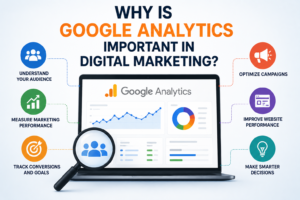
Digital marketing involves different channels such as SEO, social media marketing, Google Ads, email marketing, content marketing, and affiliate marketing. Without proper measurement, it can be difficult to know which channels are working effectively.
Google Analytics helps marketers measure the performance of these activities.
For example, suppose a company publishes a blog article about digital marketing. The article receives visitors from Google search, Instagram, and paid advertising. Google Analytics can help the marketer understand how users from these different sources behave.
If visitors from organic search spend more time reading the content and complete more conversions than visitors from another channel, the marketer may decide to invest more effort into SEO.
This is one of the biggest advantages of analytics: data can guide marketing decisions.
Understanding Website Traffic
One of the basic uses of Google Analytics is understanding website traffic.
A marketer can analyze how users arrive at a website. Common traffic sources include:
- Organic search
- Direct traffic
- Social media
- Paid search
- Referral websites
- Email campaigns
This information is useful because every traffic source can behave differently.
For example, a website might receive thousands of visitors from social media but very few conversions. At the same time, organic search might generate fewer visitors but significantly more leads.
Looking only at traffic numbers could make social media appear more successful. However, analyzing conversions and user engagement could reveal a different story.
Therefore, digital marketers should not focus only on the number of visitors. They should also analyze the quality of traffic.
Important Google Analytics Metrics 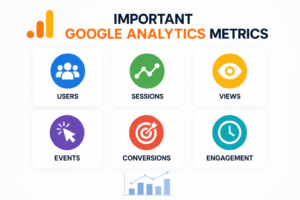
Google Analytics provides many metrics that can help marketers understand website performance. Some of the most important ones include:
Users
Users represent people who interact with a website or app. This metric helps marketers understand the size of their audience.
Sessions
A session represents a period of user interaction with a website or application. Sessions help marketers understand how frequently users interact with their digital platform.
Engagement
Engagement helps marketers understand whether visitors are actively interacting with content. Highly engaged visitors are generally more valuable than visitors who leave immediately without meaningful interaction.
Views
Views show how many times pages or screens have been viewed. This helps marketers identify popular content.
Events
Events are particularly important in GA4. An event can represent an interaction such as clicking a button, watching a video, downloading a file, submitting a form, or completing another action.
Conversions
Conversions are important actions that support a business goal. Depending on the business, a conversion could be a purchase, lead submission, registration, phone call, or newsletter signup.
Understanding these metrics helps marketers move beyond simple traffic measurement and focus on meaningful business outcomes.
Google Analytics and SEO
Google Analytics can be extremely useful for Search Engine Optimization (SEO).
SEO is the process of improving a website so that it can attract more relevant organic traffic from search engines. Google Analytics helps marketers understand what happens after users arrive through organic search.
For example, marketers can analyze which landing pages receive organic traffic and whether those visitors engage with the website.
However, it is important to understand that Google Analytics and Google Search Console serve different purposes. Search Console provides search-related information such as search queries, impressions, clicks, and search visibility, while Google Analytics focuses more on what users do after interacting with the website.
Using these tools together can provide a stronger understanding of SEO performance.
Google Analytics for Content Marketing
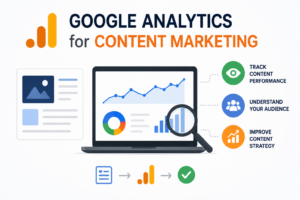
Content marketing depends heavily on understanding what audiences find useful.
A business might publish blogs, guides, videos, case studies, and other content. Google Analytics can help identify which content attracts visitors and generates engagement.
For example, imagine a digital marketing website publishes ten blog posts. One article receives significantly more engaged traffic and generates more leads than the others.
This information can influence future content strategy.
The marketer could investigate why that article performed well. Perhaps the topic has strong search demand, the article provides practical information, or the page has a strong call-to-action.
The goal is not simply to create more content. The goal is to create content that produces meaningful results.
Google Analytics and Social Media Marketing
Social media platforms can generate significant website traffic. However, marketers need to know whether that traffic contributes to business objectives.
Google Analytics can help marketers evaluate traffic coming from social platforms.
For example, a business may promote a product on Instagram and receive website visits from the campaign. By properly tracking campaign traffic, marketers can evaluate user engagement and conversions.
This makes it easier to compare social media campaigns and determine which campaigns deserve more attention.
Using campaign tracking parameters such as UTM parameters can also help marketers identify specific campaigns, sources, and mediums.
Google Analytics for Paid Advertising
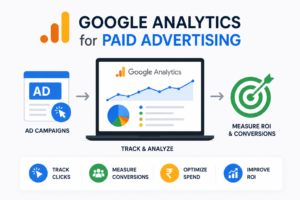
Paid advertising can become expensive if campaigns are not properly measured.
Google Analytics can help marketers understand what users do after clicking an advertisement.
For example, a marketer may spend money on two advertising campaigns. Campaign A generates 1,000 visitors, while Campaign B generates only 500 visitors.
At first, Campaign A may appear better. But if Campaign B generates significantly more leads or sales, it could actually provide better business value.
This demonstrates why digital marketers should evaluate advertising based on outcomes rather than clicks alone.
Conversion Tracking
One of the most valuable features of analytics is conversion measurement.
A conversion occurs when a visitor completes an action that is important to the business.
Examples include:
- Purchasing a product
- Submitting a contact form
- Signing up for a service
- Registering for an event
- Downloading a resource
- Requesting a quotation
- Starting a subscription
By measuring conversions, marketers can understand whether their digital marketing efforts are contributing to business growth.
For example, an e-commerce company can analyze which marketing channels generate purchases. A service-based company can track lead submissions. A content website may track newsletter registrations.
Understanding the Customer Journey
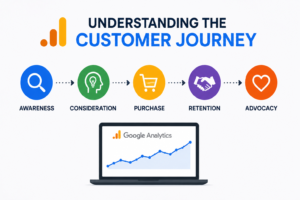
Modern customers rarely follow a simple path from advertisement to purchase.
A customer might first discover a brand through Instagram, later search for the company on Google, read a blog post, return through a direct visit, and finally make a purchase.
Analytics can help marketers understand these interactions and customer journeys.
This information is valuable because marketers can better understand how different touchpoints contribute to conversions.
Instead of asking, “Which channel got the last click?”, marketers can begin asking a more useful question: “How did different marketing interactions contribute to the customer’s journey?”
Using Google Analytics to Improve Website Performance
Google Analytics is not only about reporting. It can also help marketers identify opportunities for website improvement.
Suppose a landing page receives a large amount of traffic but generates very few conversions. This could indicate problems with the page’s design, messaging, offer, user experience, or call-to-action.
A marketer can investigate the page and test improvements.
Similarly, if a particular page has strong engagement and conversions, the business can study what makes that page effective and apply similar principles elsewhere.
This creates a continuous process:
Measure → Analyze → Improve → Test → Measure Again
This data-driven approach is one of the foundations of successful digital marketing.
Benefits of Google Analytics for Businesses
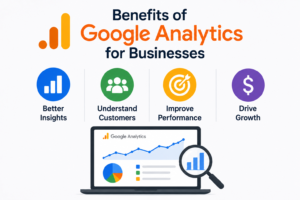
Google Analytics offers several benefits for businesses of different sizes.
First, it helps businesses make decisions based on data rather than assumptions.
Second, it helps marketers identify their most valuable traffic sources.
Third, it helps businesses understand customer behavior.
Fourth, it makes it possible to measure conversions and marketing performance.
Finally, analytics can help businesses identify areas where they can improve their website and marketing campaigns.
For small businesses especially, this can be valuable because marketing budgets are often limited. Understanding what works can help businesses use their resources more effectively.
Best Practices for Using Google Analytics
Simply installing Google Analytics does not guarantee useful insights. Businesses need to set it up and use it properly.
Some important best practices include:
Define clear goals: Before analyzing data, determine what the business wants to achieve.
Track important events: Identify actions that matter to the business and measure them appropriately.
Use campaign tracking: Use consistent campaign parameters to understand where traffic comes from.
Focus on conversions: Traffic is useful, but conversions and business outcomes are often more important.
Analyze trends: Avoid making decisions based on a single day or small amount of data. Look for meaningful patterns over time.
Respect user privacy: Analytics implementation should follow applicable privacy laws, regulations, and platform requirements.
Create useful reports: Reports should answer business questions rather than simply display large amounts of data.
Conclusion
Google Analytics is an essential tool for modern digital marketing because it helps businesses understand what happens after users interact with their digital platforms. From website traffic and user engagement to SEO, social media, paid advertising, content marketing, and conversions, analytics provides valuable information that can support better decisions.
The most important lesson is that digital marketing should not be based only on assumptions. Marketers need to measure their activities, understand the data, identify opportunities, and continuously improve their strategies.
For beginners, Google Analytics may initially seem complicated because it contains many reports, metrics, events, and settings. However, learning the fundamentals and focusing on business goals can make the platform much easier to understand.
In a competitive digital environment, businesses that understand their audience and use data effectively can make smarter marketing decisions. Google Analytics provides the information needed to turn website data into actionable digital marketing insights.
Ultimately, successful digital marketing is not just about attracting more visitors. It is about attracting the right audience, understanding their behavior, improving their experience, and turning meaningful interactions into business results.